C40 Coffee Ginder Automation
@Salt Lake City, UT
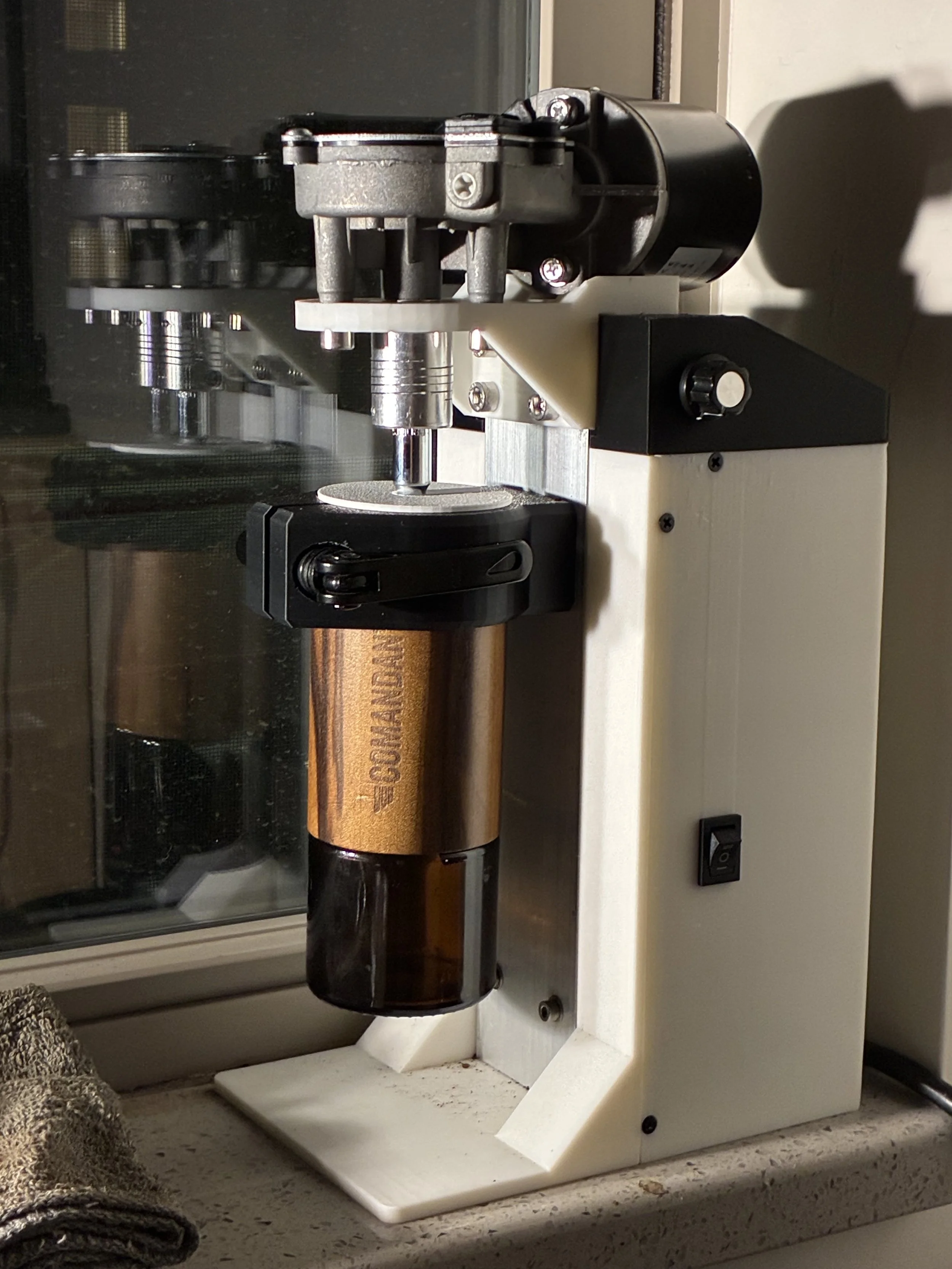
Tired of hand-grinding your morning coffee?
This project automates the iconic Comandante C40 hand grinder, converting it into a powerful, motorized countertop grinder without sacrificing its premium burr quality.
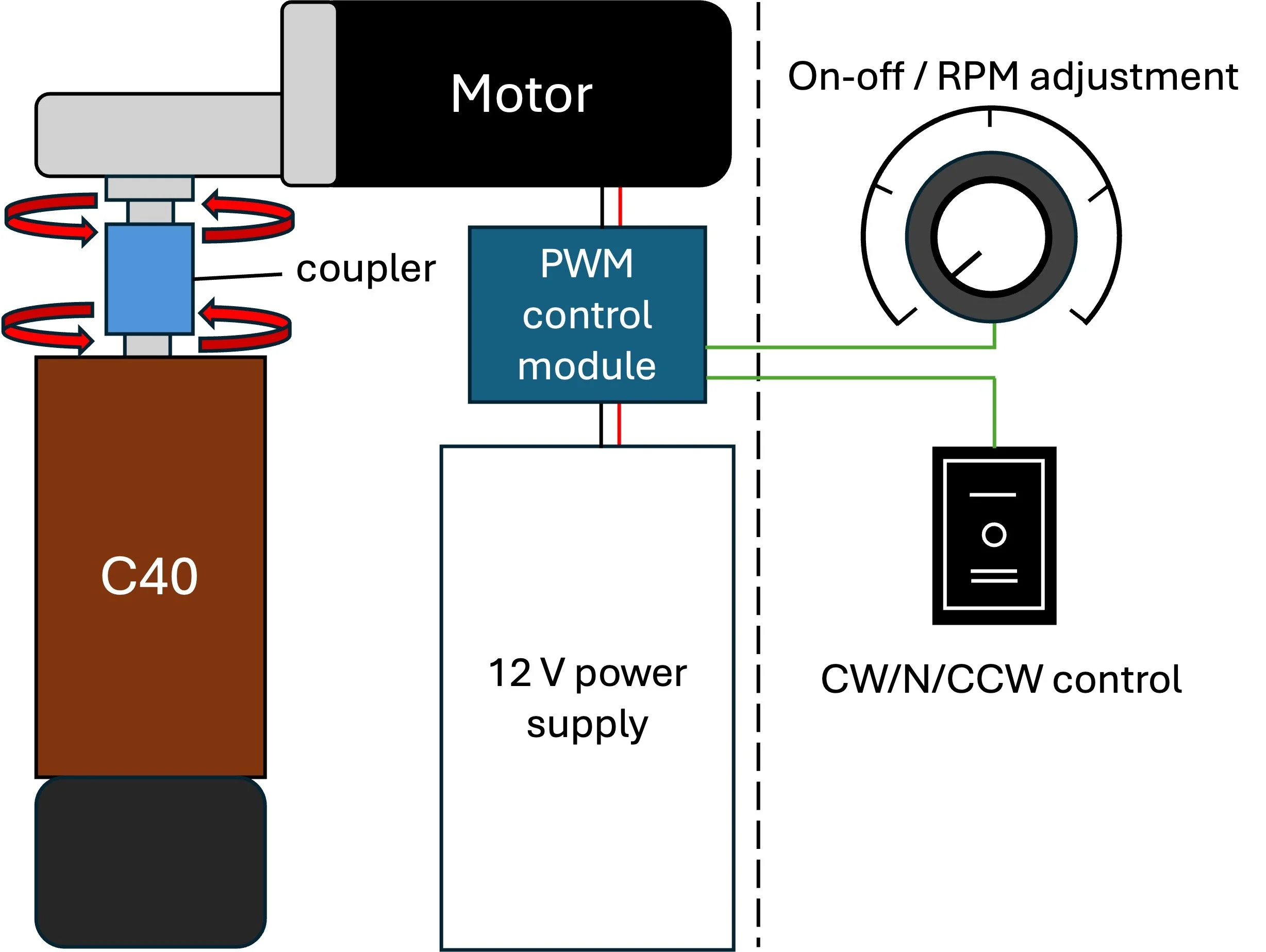
How It Works:
The Powerhouse: A high-torque motor is connected directly to the C40's drive shaft using a rigid coupler, allowing for smooth, hands-free rotation.
The Brains: A PWM (Pulse-Width Modulation) control module acts as the central hub, drawing steady power from a 12V power supply.
Full Control Interface: An On-off / RPM adjustment dial lets you fine-tune the grinding speed to minimize static and heat generation.
A 3-way rocker switch (CW/N/CCW) provides full control over Clockwise (grinding), Neutral, and Counter-Clockwise (to easily clear any stubborn or jammed beans) directions.
How much torque is needed to grind coffee beans?
How much torque does a human apply when hand-grinding coffee? We can calculate a realistic baseline using basic mechanical principles:
Leaver Arm (C40 Crank Handle): The standard Comandante handle is approximately 15 cm long.
Peak Force Required: For tough, dense, light-roast beans at a fine espresso setting, a user typically has to exert a peak force of about 15~20N at the handle tip to push through stubborn beans.
Using the torque formula:
τ= F x r
Where:
τ= Torque (N⋅m)
F = Force (N)
r = Radius/lever arm (m)
τ_peak = 20(N) x 0.15(m) = 3.0(N⋅m)
This means a motorized setup needs to comfortably deliver a baseline peak torque of at least 3 N⋅m just to replicate human grinding capability without stalling.
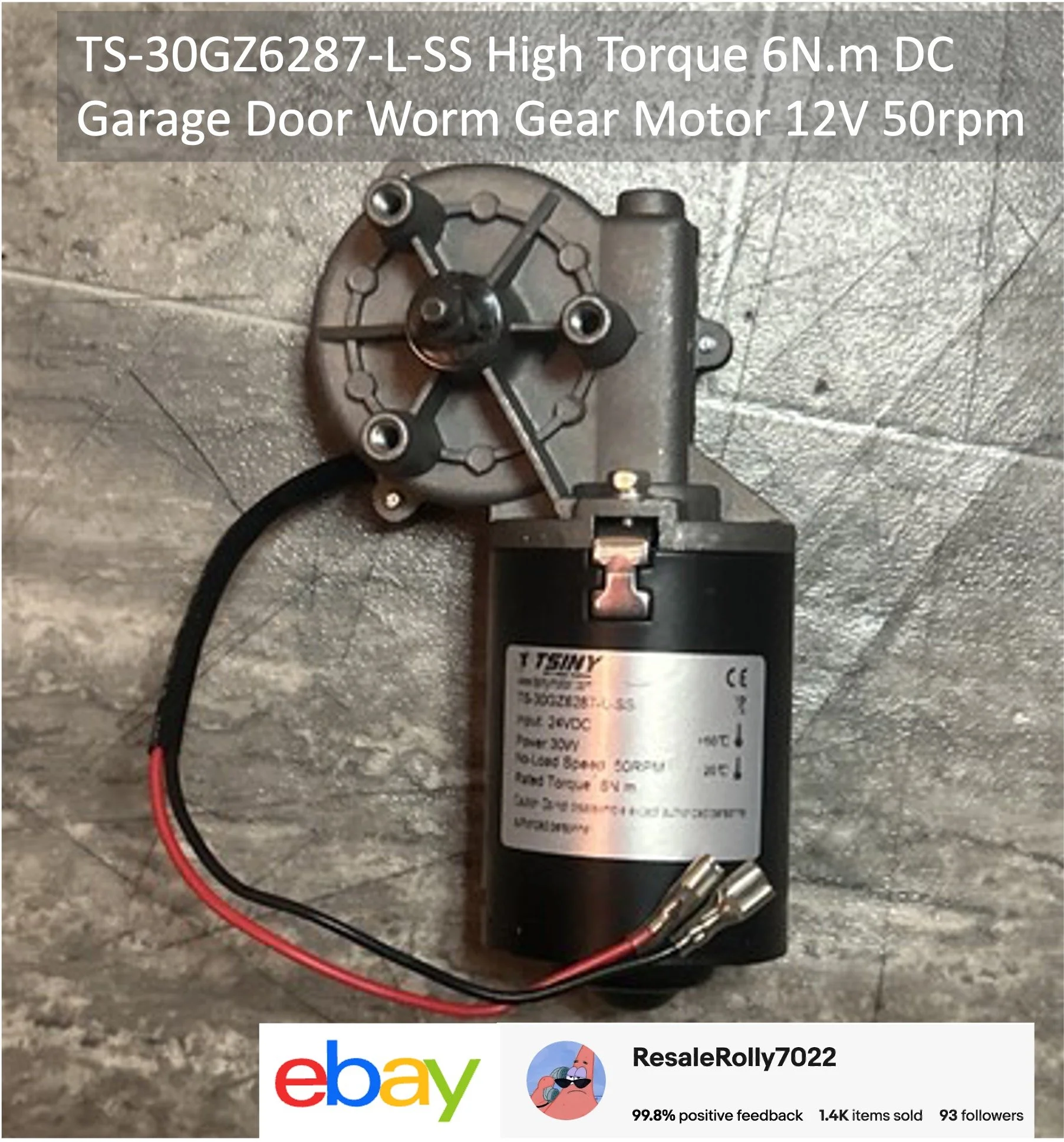
To meet this requirement, the project utilizes the TS-30GZ6287-L-SS Worm Gear Motor. Its key technical specifications include:
Rated Torque: 6 N⋅m
No-Load Speed: 50 RPM at 12V (perfect for mimicry of hand-grinding speeds to prevent heat transfer to the beans)
Gear Type: Worm Gearbox
Determining the safety factor ensures the motor can handle unexpected load spikes, such as an exceptionally hard bean, a very fine grind setting, or minor friction misalignment in the 3D-printed coupling assembly.
Safety Factor (SF)=6.0 N⋅m / 3.0 N⋅m = 2.0
This guarantees that the motor will smoothly chew through the hardest light roasts at espresso-level settings without risking a stall, while keeping the overall footprint compact enough for a countertop appliance.
How to stabilize the motor & the grinder during high-torque grinding operations?
With the motor producing 6 N⋅m of torque, securing the C40 body is crucial. Without rigid stabilization, the motor will spin the outer chassis instead of the internal burrs. The fixture relies on a high-friction, quick-release mechanism to counteract this rotational force.
Quick-Release Clamping Mechanism
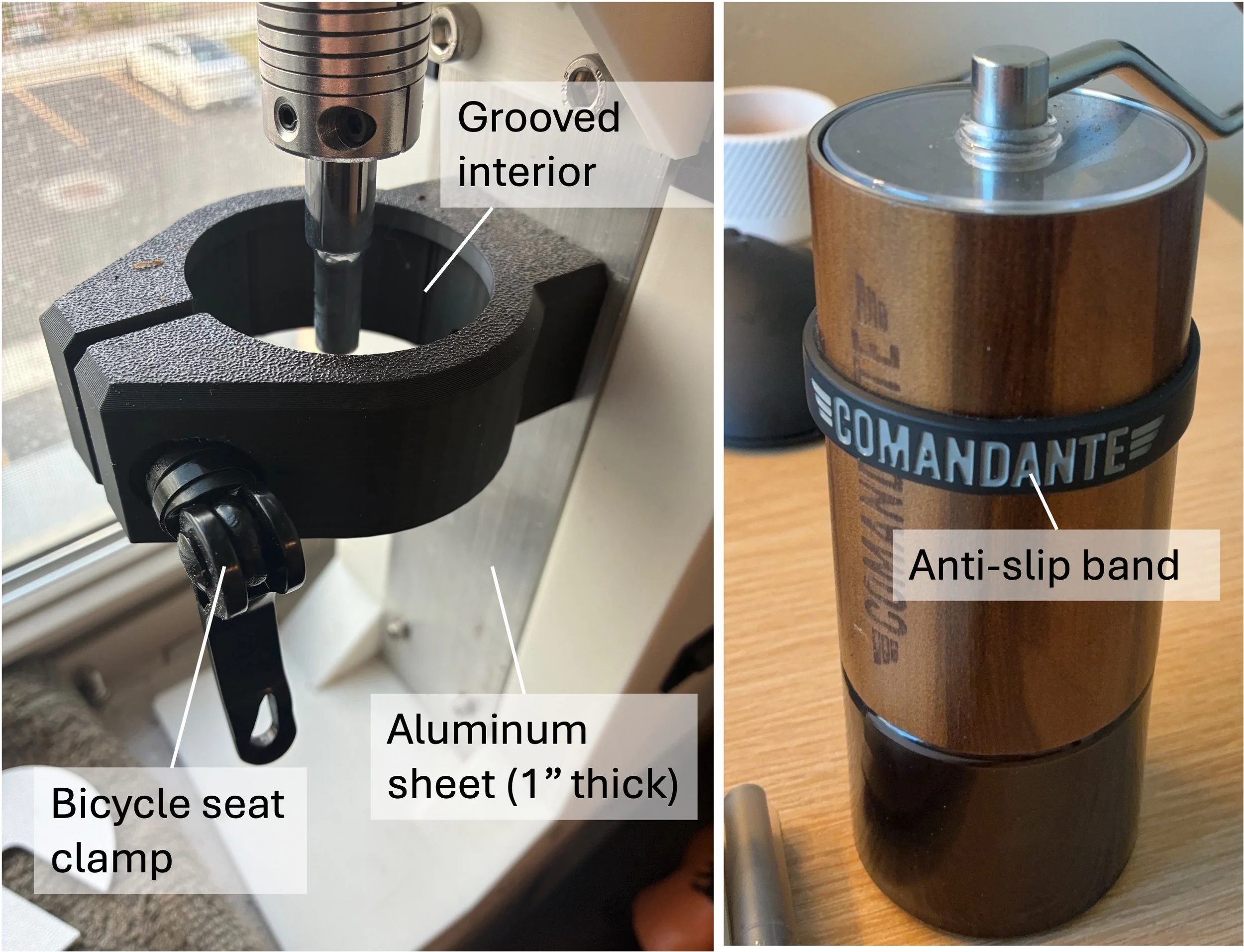
The design utilizes a heavy-duty, 3D-printed collar paired with a bicycle seat post quick-release clamp. This provides tool-free operation, allowing the grinder to be locked down securely or removed for travel in seconds. The circular collar distributes clamping pressure evenly, preventing damage to the wooden veneer.
Slip Prevention via Mechanical Interlock
To stop the smooth cylindrical body from slipping under peak loads, the fixture integrates the grinder's stock rubber parts:
Anti-Slip Band: The rubber Comandante grip band remains on the chassis to act as a high-friction interface.
Grooved Interior: The inside of the 3D-printed clamp features a precise grooved interior recess that encapsulates the silicone band. This creates a physical mechanical interlock, completely halting vertical and rotational slippage.
Structural Rigidity
To absorb motor vibrations and counter-bending moments, the clamp and the motor rack are mounted directly to a 1-inch-thick aluminum column. This massive structural backing ensures the entire assembly remains completely rigid and perfectly aligned during operation.
Final thoughts
So far, I’ve tried some light roast coffee beans with the espresso settings (at ~5), and it worked perfectly. For the housing design, I eventually chose to expose the motor body because I like how “mechanical” it looks. Hearing it grinding beans is now part of my morning routine!
Parts used in this project
Motor: TS-30GZ6287-L-SS Worm Gear Motor, rated 6 N⋅m, 50 RPM at 12 V (ebay)
12V 10A power supply: amazon.com/dp/B078RTV9C4?ref=ppx_yo2ov_dt_b_fed_asin_title
PWM controller: https://www.amazon.com/dp/B07TSJ3XPQ?ref=ppx_yo2ov_dt_b_fed_asin_title
Aluminum sheet: https://www.amazon.com/dp/B0GCHP1LYR?ref=ppx_yo2ov_dt_b_fed_asin_title&th=1
10 mm to 12 mm coupler: https://www.amazon.com/dp/B082CRL4H2?ref=ppx_yo2ov_dt_b_fed_asin_title&th=1
1/4” to 7/32” socket (for driving C40’s shaft): https://www.amazon.com/dp/B07QF1CTPT?ref=ppx_yo2ov_dt_b_fed_asin_title&th=1
Bicycle seat quick-release clamp: https://www.amazon.com/dp/B07Y3TSZBH?ref=ppx_yo2ov_dt_b_fed_asin_title
Housing: self-designed, 3D printed by ELEGOO NEPTUNE PRO 3 with PLA+ : https://www.thingiverse.com/thing:7366009